

Key Takeaways
- Centralize all supplier rates and route legs in one platform to instantly surface optimal pricing, improving quote accuracy and helping forwarders consistently offer best-price, shortest-route options.
- Automate daily rate updates, including tariffs, surcharges, and documentation, to ensure every quote reflects the latest costs, reducing errors and rework.
- Use built-in calculations for pre/on carriage and compare options quickly to speed up decision-making and significantly increase quote turnaround.
- Store all rate, route, and quote data in one system with reporting and history tracking to improve visibility, control, and future pricing decisions.
- Wisor’s platform enables faster quoting, better process control, and improved customer experience through end-to-end digital rate management and shipment oversight.
When creating price quotes for clients, freight forwarders often face the daunting task of sorting through countless data points. As clients demand to swiftly receive the “best-price, shortest-route” proposals, forwarders find themselves wishing for more efficient tools to streamline their work.
Incorporating a digital platform can alleviate many of these challenges for freight forwarders. Within a comprehensive platform, they can not only generate optimal quotes but also effectively manage the entire door-to-door supply chain cycle.
Top 10 Digital Features for Freight Forwarders
1. Optimal Price Display
Centralizing all price details from multiple suppliers for each leg of every route enables the freight forwarder to issue the most optimal price quote to the shipper.
2. Automated Rate Updates
Cargo price rates, influenced by various factors, can fluctuate daily. When the platform automatically updates these changes, including packing, documentation, tariffs, and surcharges, the freight forwarder gains a comprehensive and precise understanding of pricing. Subsequently, they can issue the most updated quote to the client.
3. Pre/On Carriage Calculation
An automated calculation for Per/on carriages loading can be particularly beneficial, especially in markets where manual calculation proves to be complex and confusing.
4. Customized and Branded Quotes
A freight forwarder can differentiate itself from competitors by providing clients with personalized, tailored, and branded quotes. Using a digital rate management system allows the freight forwarder to incorporate their logo, special features, and design, resulting in a branded and highly customized quote.
5. Fast Quotation and Comparison
With all data points updated in a single digital platform, freight forwarders can quickly and effortlessly compare the information, enabling them to present the shipper with the optimal quote.
6. Increase in Quote-Generating Pace
A digital platform enables freight forwarders to issue quotes faster, saving time and effort for both themselves and their clients.
7. Have the Entire Data All in One Place
Centralizing all price and route components in one place facilitates control over current and past information, improving the freight forwarder’s management of the entire freight process.
8. Reports
A digital platform provides various reports, aiding freight forwarders in effectively managing their entire activities.
9. Easier Overview of Past Activities
The digital platform saves all data, establishing an archive of past quotes for easy reference.
10. Enhanced Customer Experience
Employing a digital platform enables shippers to receive superior service from their freight forwarders. From expedited quote generation to enhanced management and tracking of routes, the entire door-to-door cycle benefits from improved efficiency and supervision.
Expert Tip: Build a Rate Engine that Thinks Like an Operator, Not a Spreadsheet
- Normalize every rate input before quoting: Map carrier tariffs, surcharges, and accessorials into a single structure. This prevents missed fees and avoids underquoting, which is critical as spot rates have dropped ~76% since 2021 and margins are tight.
- Automate rate validity and trigger alerts: Set rules for expiry, GRI updates, and fuel changes. Daily volatility means outdated rates directly translate into lost deals or negative margin shipments.
- Pre-calculate door costs, not just port-to-port: Include pre/on carriage, customs, and last-mile at quote stage. This aligns with growing demand for full door pricing as multimodal routing increases.
- Log every quote decision for reuse: Store lane, carrier choice, and margin logic. Over time, this becomes a pricing playbook your team can reuse to respond faster and more consistently.

Insight by
Nadav Shitrit
VP of AI, Wisor
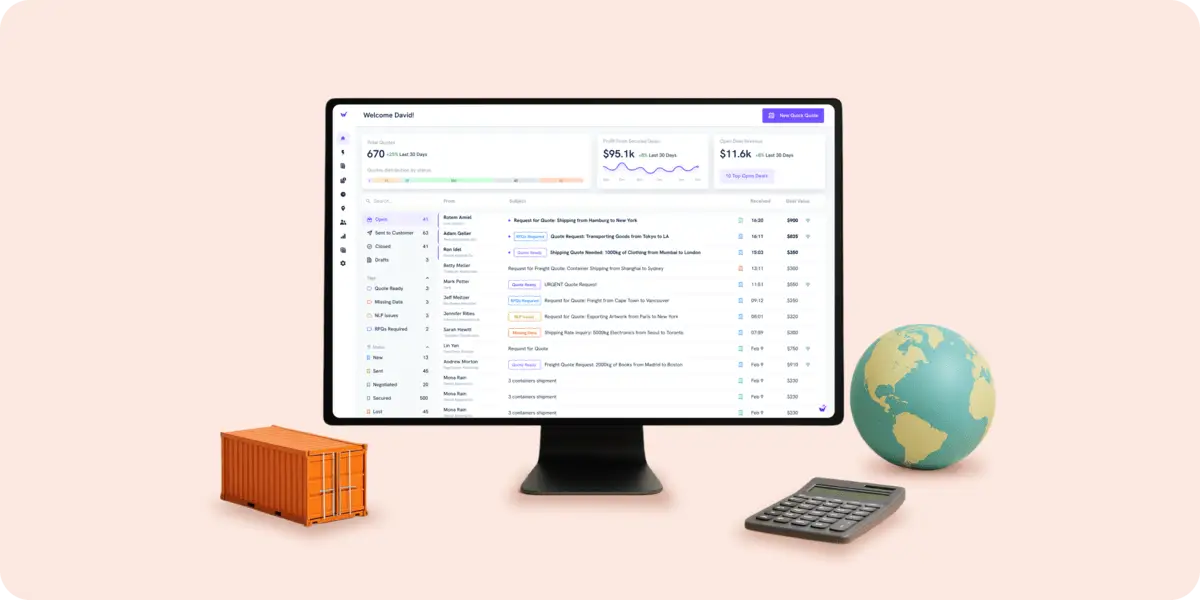
Wisor AI’s Digital Platform Helps Freight Forwarders Improve Their Services
As global supply-chain management grows increasingly complex and shippers expect to receive the best quotes, Freight forwarders are in search of more advanced solutions to enhance their business operations.
By employing a comprehensive digital rate management platform, freight forwarders can efficiently manage the entire route cycle for shippers.
Using Wisor AI’s technology can help freight forwarders gain better control over their entire shipping processes. Book a demo with us and we’ll show you how! https://wisor.ai/