

Key Takeaways
- TEU (20-foot container) is the base unit for vessel capacity and works best for dense, heavy cargo that hits weight limits before space, improving safety, load balance, and handling efficiency.
- FEU (40-foot container) equals two TEU and suits light, bulky, or consolidated freight, reducing lifts, handling time, and per-unit shipping costs for high-volume cargo.
- Choosing TEU vs FEU depends on cargo density, inland weight limits, and equipment availability; misalignment leads to wasted space, overweight risk, or higher total landed costs.
- Carriers plan and price capacity in TEU, counting each FEU as two slots; understanding this logic is critical for forecasting, contract negotiation, and rate comparison.
- Wisor helps optimize TEU and FEU decisions by analyzing cargo data, modeling total costs and surcharges, and comparing scenarios across trade lanes to improve container utilization and freight planning accuracy.
What Is TEU?
TEU, short for twenty foot equivalent unit, is the standard measure for container size in global shipping. One TEU equals a single 20-foot container, providing a consistent metric for vessel capacity, port planning, and cargo volume calculations. A TEU container is well-suited for dense, heavy goods like metals, machinery, or industrial components, where weight reaches the limit before space does.
On container ships and container vessels, capacity is often expressed in TEU, helping planners allocate slots, balance loads, and optimize container capacity efficiently. Using TEU ensures precise handling, safer stacking, and simplified terminal operations, making it a critical unit for freight planning and scheduling.
What Is FEU?
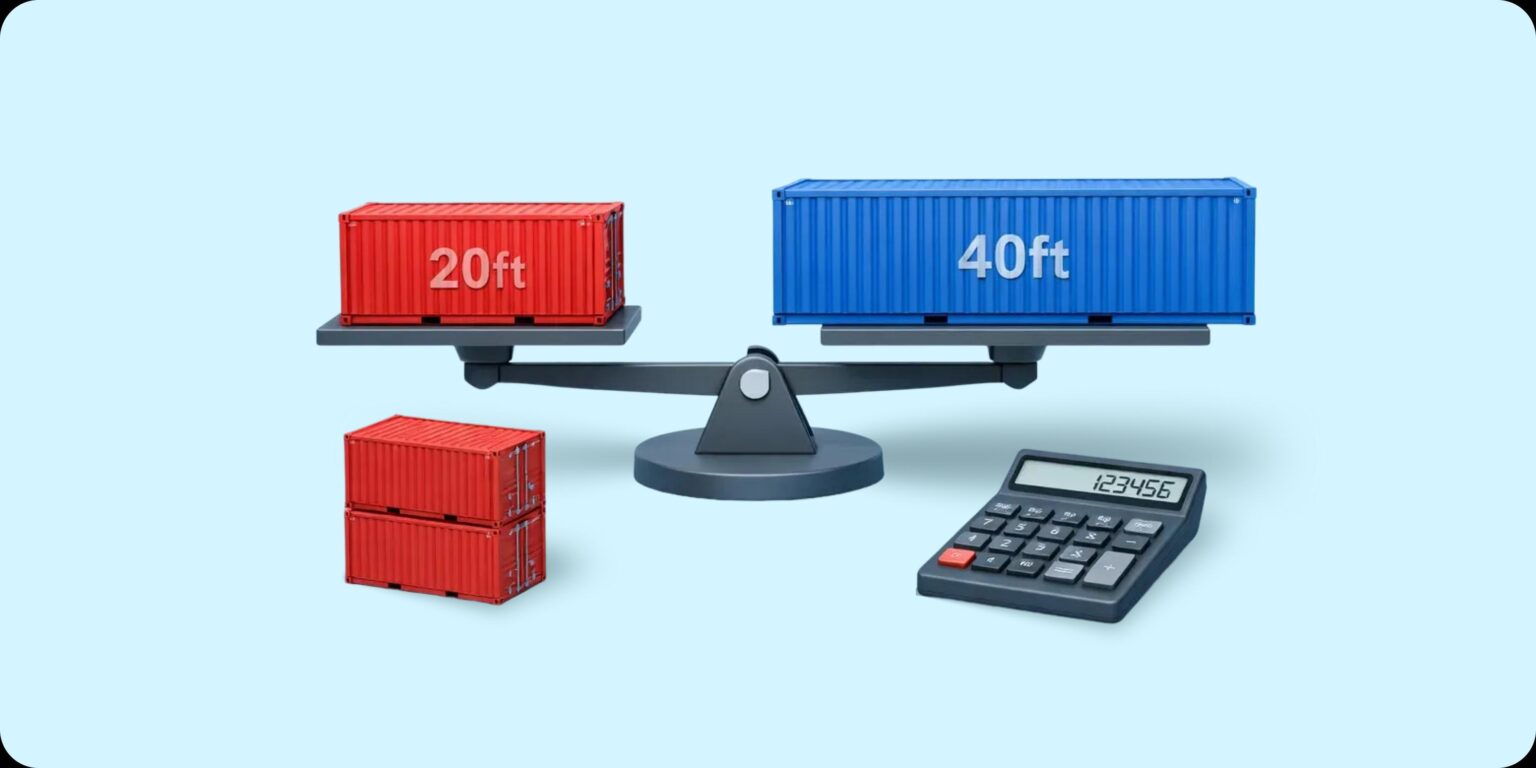
A FEU, or forty foot equivalent unit, represents a container twice the length of a TEU, equal to two twenty foot equivalent units. It is commonly used for light, bulky, or high-volume shipments that fill space faster than they reach weight limits.
A single FEU reduces the number of lifts, improves container capacity, and lowers handling time at ports and warehouses. On container ships, planners often combine TEU and FEU containers to maximize deck space, balance weight, and minimize shipping costs.
FEU is ideal for retail, consumer goods, and consolidated shipments, providing efficiency for large-scale freight operations while maintaining flexibility across trade lanes.
Key Differences Between TEU and FEU
The choice between TEU vs FEU shapes how freight fits, moves, and costs across the supply chain. Both units describe shipping containers, yet they differ in size, load limits, and pricing logic. Seeing these differences in one view helps planners match cargo capacity with vessel space on container ships and container vessels, without trial and error:
| Aspect | TEU |
FEU |
| Definition | Twenty foot equivalent unit | Forty foot equivalent unit |
| Standard Length | 20 feet | 40 feet |
| Volume | Base reference unit | About double a TEU |
| Typical Use | Dense, heavy cargo | Light, bulky cargo |
| Weight Efficiency | Reaches max weight fast | More space before weight limit |
| Slot Use on Vessels | 1 TEU slot | 2 TEU slots |
| Planning Impact | Easier weight control | Better container capacity use |
| Cost Logic | Lower risk of overweight | Lower shipping costs per unit of volume |
| Role in Capacity Charts | Base measure | Counted as two TEU |
| Common Pairing | Used alone or in sets | Mixed with TEU and FEU containers |
When to Use TEU vs FEU
The TEU vs FEU decision comes down to load density, handling limits, and space use on container ships. Choosing the right unit helps match cargo capacity with vessel slots and keeps shipping costs stable across the route.
Best Use Cases for TEU Containers
- Exporting Steel Coils: Dense steel coils can quickly exceed weight limits. Shipping them in a TEU allows precise weight management, ensures cranes and trucks handle the load safely, and reduces the chance of port penalties.
- Machinery Components to Regional Ports: Small batches of heavy machinery fit well in TEU units, keeping shipments within local handling limits while simplifying terminal operations and maintaining secure load placement.
Best Use Cases for FEU Containers
- Retail Stock Shipments: Light but bulky goods like packaged apparel or electronics can fill an entire FEU, improving space utilization, reducing the number of containers needed, and minimizing handling time at ports.
- Consolidating Multiple Client Orders: Combining several small shipments into a single FEU reduces repeated moves, lowers labor costs, reduces freight costs, and keeps cargo organized for faster distribution across warehouses or retail locations.
These examples highlight how matching TEU and FEU containers to cargo type and route constraints ensures cost-effective, efficient freight planning.
TEU and FEU Capacity Planning for Freight Efficiency
Effective planning with TEU and FEU aligns cargo type, vessel space, and inland handling. The right balance improves container capacity, reduces rework, and supports steady flow across container ships, ports, and warehouses without inflating shipping costs.
Pallet and Cargo Load Planning
Pallet layout determines how well TEU and FEU containers are used. TEU suits dense, heavy cargo, while FEU works for lighter, bulkier shipments. Mapping pallet size, stack height, and gaps prevents wasted space, ensures safe weight distribution, and speeds terminal handling.
High-Cube and Specialty Container Considerations
High-cube and specialty containers increase volume without doubling weight. They expand container capacity for tall or irregular cargo. Planning must account for internal height, securing points, and vessel limits to avoid rebooking or poor load balance.
Optimizing Space Across Ships and Warehouses
Capacity planning extends from the vessel to the warehouse. Aligning container mix, yard slots, and racking systems ensures smooth flow, reduces idle time, and keeps TEU and FEU containers efficiently utilized from port to storage.
TEU vs FEU in Supply Chain and Transportation Operations
In operational planning, TEU vs FEU affects forecasting, cargo flow, and efficiency across ports, vessels, and inland transport. Using TEU and FEU containers as planning units helps operators balance space, reduce delays, and optimize costs across the supply chain.
- Vessel Capacity Planning and Forecasting: Capacity planning on container ships uses TEU as the base unit, with each FEU counted as two slots. This affects booking limits, seasonal forecasts, and stowage balance for mixed TEU and FEU containers, ensuring vessel space is fully optimized.
- Inventory Turn and Container Flow Efficiency: Using TEU supports faster inventory turnover for dense or high-frequency goods, while FEU units allow consolidation of lighter, bulkier cargo. Proper selection improves container capacity utilization and maintains smooth flow through warehouses, ports, and transport legs.
- Terminal Throughput and Congestion Impacts: Terminals track moves in TEU, so high FEU ratios reduce crane cycles and yard congestion, while high TEU volumes increase lifts but provide better weight distribution control. This balance directly affects efficiency and handling times for shipping containers.
- Intermodal Compatibility Across Rail, Road, and Sea: TEU units generally comply better with rail and road weight restrictions, while FEU units maximize cargo capacity at sea. Aligning container choice with inland transport rules ensures smooth transfers and avoids bottlenecks between vessels, trucks, and trains.
TEU and FEU Cost Drivers and Freight Rate Dynamics
Costs in container shipping go beyond simple size. Choosing TEU vs FEU influences shipping costs, contract pricing, and exposure to surcharges. Planners must account for rate structures, seasonal demand, equipment availability, and hidden fees. Let’s elaborate on these aspects in the following table:
| Cost Factor | TEU | FEU | Impact on Freight Planning |
| Freight Rate Differences Between TEU and FEU Contracts | Often priced per unit, sometimes slightly higher per TEU due to handling. | Usually slightly lower per TEU equivalent; one FEU covers two TEU slots. | Impacts contract negotiation and bulk rate strategies; choosing FEU can reduce per-unit cost for volume shipments. |
| Peak Season, Demand Shifts, and Bunker Surcharges | Susceptible to surcharges during high demand or fuel cost spikes. | Same surcharges apply, but per FEU unit effect spreads over more cargo. | Seasonal forecasting helps select TEU vs FEU based on expected surcharges and capacity limits. |
| Equipment Availability and Container Imbalance Costs | TEU units are more abundant, easier to source; fewer empty repositioning costs. | FEU units can be limited, causing repositioning fees and extra logistics cost. | Affects fleet planning and port handling; selecting units depends on local availability and balance of import/export flows. |
| Tariffs, Accessorials, and Hidden Cost Factors | Fees per unit, including port handling, storage, and documentation. | Fees apply per unit, often giving FEU a cost advantage per TEU equivalent. | Critical for accurate total landed cost; planners must include all hidden cost factors when comparing TEU vs FEU. |
TEU vs FEU in Contract Interpretation and Pricing Strategy
Understanding TEU vs FEU in contracts is essential for controlling shipping costs and maximizing container capacity. Proper interpretation ensures planners account for base rates, surcharges, and hidden fees, allowing more accurate budgeting and better alignment of container selection with cargo type and vessel space.
Understanding Freight Rates per Container
Freight rates are typically expressed per TEU, with each FEU counted as two slots. Planners must factor in base rates, fuel surcharges, seasonal adjustments, and port fees to assess the true cost. Evaluating TEU and FEU containers side by side helps determine whether the volume advantage of an FEU outweighs potential surcharges, ensuring cost-effective freight planning and efficient vessel loading.
Negotiating TEU vs FEU Agreements
Negotiation involves comparing total costs per TEU and FEU, including handling, documentation, and surcharge fees. Carriers often offer discounts for bulk FEU shipments, while TEU remains flexible for smaller or high-density cargo. Clear agreements reduce repositioning fees, clarify responsibility for overweight loads, and optimize container capacity usage across trade lanes.
Reading Rate Tables and Tariffs
Rate tables outline base charges per TEU, while surcharges and accessorials, such as port handling or storage fees, can significantly affect total cost. Understanding these for TEU and FEU enables planners to anticipate expenses accurately, compare options effectively, and allocate vessel, terminal, and warehouse space efficiently. This ensures total landed cost, not just the base rate, guides container strategy.
Key Challenges in TEU and FEU Planning
Planning with TEU and FEU is not just about size; it requires balancing weight, volume, and route constraints. Mistakes can lead to wasted container capacity, higher shipping costs, and delays across container ships and terminals. Understanding these common challenges helps shippers make smarter, more efficient freight decisions:
- Misestimating Volume vs Weight Requirements: Using a TEU for light, bulky cargo can underutilize space, while an FEU for dense goods may exceed weight limits. Accurate assessment of cargo density is essential to avoid inefficiency and port penalties.
- Choosing the Wrong Container Type for Specific Cargo: Selecting between TEU vs FEU containers without considering cargo dimensions, pallet size, or stacking rules can create handling problems, poor space utilization, or increased labor costs during loading and unloading.
- Overfitting or Underfitting Shipments Across Routes: Booking too many FEU units on a lightly loaded route wastes container capacity, while relying solely on TEU for high-volume lanes may require extra moves, increase shipping costs, and reduce operational efficiency.
Best Practices for TEU vs FEU Freight Planning
Choosing between TEU and FEU is one of the most practical decisions in freight planning, yet it is often reduced to container size alone. In reality, the choice affects container capacity, cost control, equipment availability, and how smoothly cargo moves across ports, vessels, and inland transport. The following best practices focus on aligning container selection with cargo density, trade lane limits, and inventory cycles:
| Best Practice | Description | Impact |
| Match Container to Cargo | Use TEU for dense cargo, FEU for light or bulky goods | Optimizes space and weight use |
| Avoid Paying for Unused Space | Don’t use FEU when a TEU suffices | Reduces unnecessary shipping costs |
| Check Equipment Availability | Consider local container supply and port limits | Prevents delays and repositioning fees |
| Compare Total Landed Cost | Include surcharges, fees, and accessorials | Ensures accurate cost assessment |
| Scenario Modeling | Test different TEU vs FEU mixes and routes | Identifies cost-efficient strategies |
| Align with Inventory Cycles | Match container choice to stock and replenishment schedules | Improves flow and avoids idle containers |
How Wisor Optimizes TEU and FEU Decisions
Wisor helps shippers make smarter TEU vs FEU choices by combining data analytics, cost modeling, and operational insights. Its tools allow freight planners to optimize container capacity, reduce shipping costs, and improve overall supply chain efficiency across multiple trade lanes.
- Data-Driven Container Selection Across Trade Lanes: Wisor analyzes historical shipment data, cargo type, and vessel availability to recommend the optimal mix of TEU and FEU containers for each route.
- Freight Cost Forecasting for TEU and FEU Scenarios: The platform models base freight rates, surcharges, and hidden fees for both container types, allowing planners to anticipate shipping costs under different conditions.
- Improving Container Utilization and Supply Chain Flow: By evaluating cargo density, volume, and vessel slot use, Wisor ensures that both TEU and FEU containers are fully loaded, reducing empty space and improving terminal efficiency.
- Scenario Comparisons to Identify Cost-Saving Options: Wisor enables side-by-side comparisons of TEU vs FEU strategies under peak season, equipment constraints, and route variability to highlight the most economical choices.
- Supporting Smarter Procurement and Freight Planning Decisions: Insights from Wisor guide container bookings, negotiate better rates, and align shipping schedules with inventory cycles, helping companies make informed and cost-efficient decisions.
Conclusion
Choosing between TEU and FEU is a critical part of freight planning that affects container capacity, shipping costs, and overall supply chain efficiency. Understanding the differences in size, weight limits, cost structures, and operational impacts allows planners to match container type to cargo, route, and vessel constraints.
Tools like Wisor help freight forwarders by supporting data-driven decisions, improving load planning, cost forecasting, and intermodal efficiency in both air and sea freight. Informed TEU vs FEU choices ensure smoother operations, lower costs, and smarter container management across the supply chain.